
It is that time of year when the game of golf is in, pardon the pun, full swing. Bags are being dusted off, clubs are being inspected and cleaned, and new and used balls are being purchased. This is the perfect opportunity to take a look at some historic, old, new, and unusual American golf courses and the players who played on them. Take a trip with us across the country and through time for a nostalgic look at some of the links that have made this great game even more exceptional.
A Brief History of the Game

A form of golf can be traced back to ancient Rome, where players used a bent stick and a stuffed leather ball. The origin of the game as we know it, however, is typically attributed to the Scots. It was such a popular game in the fifteenth century, the Scottish Parliament banned the practice of golf because it was hindering archery practice and jeopardizing national defense.
The first Open Championship (British Open) was held in 1860 at Prestwick in Scotland with Willie Park Sr. winning the championship. In 1894, The United States Golf Association (USGA) formed, primarily to serve as the arbiter for questions of amateur status. The first U.S. Amateur Championship and the U.S. Open were played at Rhode Island’s Newport Country Club in 1895. The first US Women’s Amateur Golf Championship was also played that year at Meadow Brook Club in Long Island. In 1934, the first Masters was staged.
Looking ahead, in 2016, golf will be included at the Olympic Games in Rio for the first time in 112 years.
Augusta National Golf Club
Even those who aren’t players or fans of the game have heard of the internationally renowned Augusta National Golf Club in Augusta, Georgia. It is a course designed by Alister MacKenzie and Bobby Jones in 1933. Since 1934, it has annually hosted the Masters Tournament and has continuously ranked high on the lists of Golf Digest, GolfLink.com, and Golf.com. In fact, an article in Golf Digest listed Augusta National as the first in its ranking of America's 100 greatest courses.
In 1997, Tiger Woods set the tournament record at 18-under-par 270 and dominated the par-5 holes. It is a beautiful, majestic and challenging course and playing in the Masters is very golfer’s dream. Many notable golfers have enjoyed the course including Jack Nicklaus and Ben Crenshaw. It is unfortunate that MacKenzie, who proclaimed that the Augusta was his greatest design, didn’t live to see the first Augusta National Invitation Tournament played on his creation.
Pebble Beach Golf Links

Image Source: https://golf50in10.wordpress.com/2014/01/14/2014-in-preview/
Teeing up at Pebble Beach is a considerable thrill and golfers who play there know that they are sharing the green with some of the biggest legends of the game. Some of the greatest moments in the history of golf have occurred there.
Opened in 1919 and designed by Jack Neville and Douglas Grant, the course follows a magnificent and rugged coastline that affords the players incredible views, sloping greens and fairways alongside breathtaking cliffs. Although considered to be one of the most challenging courses in the world, it can be enjoyed by golfers of all skill levels. Pebble Beach has been home to some of the most eminent and respected championships. These include five U.S. Open Championships and the annual AT&T Pebble Beach National Pro-Am. The U.S. Open will be back in 2019.
In 1963, during the third round of a tournament, Arnold Palmer hit a shot on hole 17 that would end his 47 consecutive tournaments in the money. The ball appeared to disappear in the ocean, and Palmer invoked the lost ball rule and teed up with a new ball. The original ball was found in the rocks, and the PGA ruled that he had essentially abandoned the first ball and disqualified him.
The Oldest Course in the U.S., The Chicago Golf Club
The Chicago Golf Club in Wheaton, Illinois, a private golf club, is the oldest 18-hole golf course in North America. It was one of the five clubs the United States Golf Association inaugurated in 1894. Charles B. Macdonald, Its founder, was the winner of the first official U.S. Amateur Championship in 1895. He was referred to as Chicago’s “Father of Golf.” The course has been home to a number of tournaments including the U.S. Open, the U.S. Amateur, the U.S. Women's Amateur, the U.S. Senior Amateur, and the Walker Cup.
The Chicago Golf Club is ranked number 5 among the most select courses in the world. Membership stands at a total of 120 in perpetuity. Membership is by invitation only, through referral by an existing member.
Unusual Golf Courses
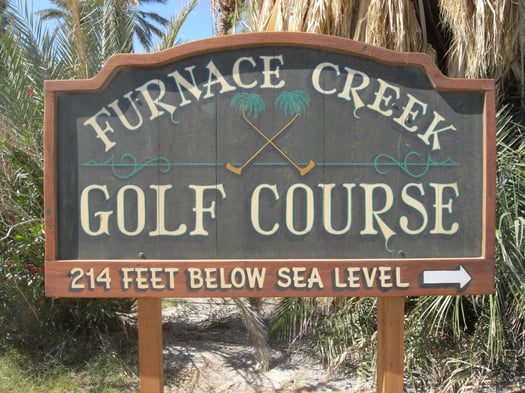
Image Source: http://edwardkerlin.org/camping.html
The Furnace Creek Golf Course in Death Valley, California, is 214 feet below sea level and resides in the middle of Death Valley, the hottest spot in the United States. Temperatures can spike to upward of 130 degrees. This golf course has the distinction of being the lowest altitude course in the world.
Fossil Trace in Golden, Colorado, is unusual in that, at one time, it was a clay mine outside of Denver. Course architect Jim Engh preserved a piece of American history by leaving dilapidated mining equipment adjacent to several holes. It is also notable--and this is where the course gets its name--for the 64 million-year-old fossils near holes 11 to 15. There are well-preserved Triceratops footprints next to the 12th green and a detailed exhibit about the property’s history in the club. Golfers and armchair archeologists have the unique opportunity to play where some of the first dinosaurs once tread.
For all their similarities, American golf courses are as varied and as interesting as the game itself. Though they all share at least 18 holes, no two are just alike. From outrageously beautiful to frustratingly challenging, American courses have earned their place in the annals of golfing heritage. The game of golf has a rich and exciting history, matched only by the skill of some of the most prominent players and the courses on which they play.
Outbound link:
http://www.augusta.com/
Source links:
http://www.augusta.com/masters/story/history/mackenzie-made-jones-dream-strategic-course-reality
http://www.igfgolf.org/about-golf/history/
http://www.pebblebeach.com/golf/pebble-beach-golf-links/course-history/palmer-on-the-rocks
https://en.wikipedia.org/wiki/Chicago_Golf_Club
http://www.forbes.com/sites/larryolmsted/2013/08/23/10-most-unusual-us-golf-courses/