---
title: Perks and Particulars of the 2015 Titleist Pro V1 & Pro V1x
description: The new 2015 Titleist Pro V1 and Pro V1x models officially hit retail stores on Jan. 30 and since then, have been garnering plenty of praise from professional players and industry publications for their innovative features—collectively designed for an overall softer feel and more spin around the greens than earlier generations.
image: https://blog.lostgolfballs.com/hubfs/Blog_Images/Prov1-prov1x-image.png
---
866.639.4819 - 8AM - 5PM (CST) M-F.
- [Best Ball For You](https://info.lostgolfballs.com/whats-the-best-ball-for-you)
- [Grading Scale](https://www.lostgolfballs.com/gradingscale)
- [Sign In](https://www.lostgolfballs.com/customer/account/login/)
- [Cart](https://blog.lostgolfballs.com/checkout/cart/)
**Lostgolfballs**
- [Golf Balls](https://www.lostgolfballs.com/golf-balls.html)
- [Golf Balls](https://www.lostgolfballs.com/golf-balls.html)
- - [Shop By Quantity](https://www.lostgolfballs.com/golf-balls/quantity.html)
- - [12 Packs](https://www.lostgolfballs.com/golf-balls/quantity/12-packs.html)
- - [48 Buckets](https://www.lostgolfballs.com/golf-balls/quantity/48-buckets.html)
- - [96 Buckets](https://www.lostgolfballs.com/golf-balls/quantity/96-buckets.html)
- - [Shop By Quality](https://www.lostgolfballs.com/golf-balls/quality.html)
- - [Mint (5A)](https://www.lostgolfballs.com/golf-balls/quality/aaaaa-1st-quality.html)
- - [Mint No Logo (Refinished)](https://www.lostgolfballs.com/golf-balls/quality/refinished.html)
- - [Near Mint (4A)](https://www.lostgolfballs.com/golf-balls/quality/aaaa-2nd-quality.html)
- - [Good (3A)](https://www.lostgolfballs.com/golf-balls/quality/aaa-3rd-quality.html)
- - [Shop By Brand](https://www.lostgolfballs.com/golf-balls/brands.html)
- - [Pro V1/Pro V1x](https://www.lostgolfballs.com/golf-balls/brands/pro-v1.html)
- - [Titleist](https://www.lostgolfballs.com/golf-balls/brands/titleist.html)
- - [Bridgestone](https://www.lostgolfballs.com/golf-balls/brands/bridgestone.html)
- - [Callaway](https://www.lostgolfballs.com/golf-balls/brands/callaway.html)
- - [Nike](https://www.lostgolfballs.com/golf-balls/brands/nike.html)
- - [Srixon](https://www.lostgolfballs.com/golf-balls/brands/srixon.html)
- - [TaylorMade](https://www.lostgolfballs.com/golf-balls/brands/taylormade.html)
- - [Kirkland](https://www.lostgolfballs.com/golf-balls/brands/kirkland.html)
- - [Snell](https://www.lostgolfballs.com/golf-balls/brands/snell.html)
- - [Volvik](https://www.lostgolfballs.com/golf-balls/brands/volvik.html)
- - [Vice](https://www.lostgolfballs.com/golf-balls/brands/vice.html)
- - [Wilson](https://www.lostgolfballs.com/golf-balls/brands/wilson.html)
- - [Shop By Assorted](https://www.lostgolfballs.com/golf-balls/assorted.html)
- - [Other Brands](https://www.lostgolfballs.com/golf-balls/assorted/other-brands.html)
- - [Colored](https://www.lostgolfballs.com/golf-balls/assorted/colored-golf-balls.html)
- - [Pink](https://www.lostgolfballs.com/golf-balls/assorted/colored-golf-balls/pink-golf-balls.html)
- - [Yellow](https://www.lostgolfballs.com/golf-balls/assorted/colored-golf-balls/yellow-golf-balls.html)
- - [Orange](https://www.lostgolfballs.com/golf-balls/assorted/colored-golf-balls/orange.html)
- - [Crystals](https://www.lostgolfballs.com/golf-balls/assorted/colored-golf-balls/crystals.html)
- - [Range/Floater Balls](https://www.lostgolfballs.com/golf-balls/assorted/range-floater-balls.html)
- - [Novelty](https://www.lostgolfballs.com/golf-balls/assorted/novelty.html)
- - [Women's Golf Balls](https://www.lostgolfballs.com/golf-balls/assorted/womens-golf-balls.html)
- - [Golf Balls for Seniors](https://www.lostgolfballs.com/golf-balls/assorted/golf-balls-for-seniors.html)
- [New Arrivals](https://www.lostgolfballs.com/golf-balls/assorted/new-arrivals.html)
- [Deals](https://www.lostgolfballs.com/deals.html)
- [Deals](https://www.lostgolfballs.com/deals.html)
- - [Sample Packs](https://www.lostgolfballs.com/deals/sample-packs.html)
- - [Used Golf Ball Clearance](https://www.lostgolfballs.com/deals/clearance.html)
- - [Practice Golf Balls & Other Value Items](https://www.lostgolfballs.com/deals/value-items.html)
- [Accessories](https://www.lostgolfballs.com/golf-accessories.html)
- [Accessories](https://www.lostgolfballs.com/golf-accessories.html)
- - [Tees](https://www.lostgolfballs.com/golf-accessories/tees.html)
- - [Gloves](https://www.lostgolfballs.com/golf-accessories/gloves.html)
- - [SuperStroke Grips](https://www.lostgolfballs.com/golf-accessories/superstroke-grips.html)
- - [Tee Time Extras](https://www.lostgolfballs.com/golf-accessories/tee-time-extras.html)
- - [Shag Bag](https://www.lostgolfballs.com/golf-accessories/shag-bag.html)
[Home](https://www.lostgolfballs.com/)
- Golf Balls
Back
Golf Balls
- [Golf Balls](https://www.lostgolfballs.com/golf-balls.html)
- - [Shop By Quantity](https://www.lostgolfballs.com/golf-balls/quantity.html)
- - [12 Packs](https://www.lostgolfballs.com/golf-balls/quantity/12-packs.html)
- - [48 Buckets](https://www.lostgolfballs.com/golf-balls/quantity/48-buckets.html)
- - [96 Buckets](https://www.lostgolfballs.com/golf-balls/quantity/96-buckets.html)
- - [Shop By Quality](https://www.lostgolfballs.com/golf-balls/quality.html)
- - [Mint (5A)](https://www.lostgolfballs.com/golf-balls/quality/aaaaa-1st-quality.html)
- - [Mint No Logo (Refinished)](https://www.lostgolfballs.com/golf-balls/quality/refinished.html)
- - [Near Mint (4A)](https://www.lostgolfballs.com/golf-balls/quality/aaaa-2nd-quality.html)
- - [Good (3A)](https://www.lostgolfballs.com/golf-balls/quality/aaa-3rd-quality.html)
- - [Shop By Brand](https://www.lostgolfballs.com/golf-balls/brands.html)
- - [Pro V1/Pro V1x](https://www.lostgolfballs.com/golf-balls/brands/pro-v1.html)
- - [Titleist](https://www.lostgolfballs.com/golf-balls/brands/titleist.html)
- - [Bridgestone](https://www.lostgolfballs.com/golf-balls/brands/bridgestone.html)
- - [Callaway](https://www.lostgolfballs.com/golf-balls/brands/callaway.html)
- - [Nike](https://www.lostgolfballs.com/golf-balls/brands/nike.html)
- - [Srixon](https://www.lostgolfballs.com/golf-balls/brands/srixon.html)
- - [TaylorMade](https://www.lostgolfballs.com/golf-balls/brands/taylormade.html)
- - [Kirkland](https://www.lostgolfballs.com/golf-balls/brands/kirkland.html)
- - [Snell](https://www.lostgolfballs.com/golf-balls/brands/snell.html)
- - [Volvik](https://www.lostgolfballs.com/golf-balls/brands/volvik.html)
- - [Vice](https://www.lostgolfballs.com/golf-balls/brands/vice.html)
- - [Wilson](https://www.lostgolfballs.com/golf-balls/brands/wilson.html)
- - [Shop By Assorted](https://www.lostgolfballs.com/golf-balls/assorted.html)
- - [Other Brands](https://www.lostgolfballs.com/golf-balls/assorted/other-brands.html)
- - [Colored](https://www.lostgolfballs.com/golf-balls/assorted/colored-golf-balls.html)
- - [Pink](https://www.lostgolfballs.com/golf-balls/assorted/colored-golf-balls/pink-golf-balls.html)
- - [Yellow](https://www.lostgolfballs.com/golf-balls/assorted/colored-golf-balls/yellow-golf-balls.html)
- - [Orange](https://www.lostgolfballs.com/golf-balls/assorted/colored-golf-balls/orange.html)
- - [Crystals](https://www.lostgolfballs.com/golf-balls/assorted/colored-golf-balls/crystals.html)
- - [Range/Floater Balls](https://www.lostgolfballs.com/golf-balls/assorted/range-floater-balls.html)
- - [Novelty](https://www.lostgolfballs.com/golf-balls/assorted/novelty.html)
- - [Women's Golf Balls](https://www.lostgolfballs.com/golf-balls/assorted/womens-golf-balls.html)
- - [Golf Balls for Seniors](https://www.lostgolfballs.com/golf-balls/assorted/golf-balls-for-seniors.html)
- [New Arrivals](https://www.lostgolfballs.com/golf-balls/assorted/new-arrivals.html)
- Deals
Back
Deals
- [Deals](https://www.lostgolfballs.com/deals.html)
- - [Sample Packs](https://www.lostgolfballs.com/deals/sample-packs.html)
- - [Used Golf Ball Clearance](https://www.lostgolfballs.com/deals/clearance.html)
- - [Practice Golf Balls & Other Value Items](https://www.lostgolfballs.com/deals/value-items.html)
- Accessories
Back
Accessories
- [Accessories](https://www.lostgolfballs.com/golf-accessories.html)
- - [Tees](https://www.lostgolfballs.com/golf-accessories/tees.html)
- - [Gloves](https://www.lostgolfballs.com/golf-accessories/gloves.html)
- - [SuperStroke Grips](https://www.lostgolfballs.com/golf-accessories/superstroke-grips.html)
- - [Tee Time Extras](https://www.lostgolfballs.com/golf-accessories/tee-time-extras.html)
- - [Shag Bag](https://www.lostgolfballs.com/golf-accessories/shag-bag.html)
Menu
[](https://palmspire-3842749.hs-sites.com/growth-home-1)
- [Home page](https://313908.hs-sites.com)
- [About Us](https://313908.hs-sites.com/about-us)
- [Management Team](https://313908.hs-sites.com/about-us/management-team)
- [Contact Us](https://313908.hs-sites.com/about-us/contact-us)
- [Products](https://313908.hs-sites.com/products)
- [Product 1](https://313908.hs-sites.com/products/product-1)
- [Product Variation 1](https://313908.hs-sites.com/products/product-1/variation-1)
- [Product Variation 2](https://313908.hs-sites.com/products/product-1/variation-2)
- [Product 1](https://313908.hs-sites.com/products/product-2)
- [Lost Golf Balls Blog](https://blog.lostgolfballs.com)
LostGolfBalls.com **BLOG**
Information and tips on everything golf ball related from the largest recycler of used golf balls in the world
- [Golf Balls](https://blog.lostgolfballs.com/topic/golf-balls)
# [Perks and Particulars of the 2015 Titleist Pro V1 & Pro V1x](https://blog.lostgolfballs.com/perks-and-particulars-of-the-2015-titleist-pro-v1-pro-v1x)
[Read More →](https://blog.lostgolfballs.com/perks-and-particulars-of-the-2015-titleist-pro-v1-pro-v1x)
### Posts by Tag
- [PGA Events (329)](https://blog.lostgolfballs.com/topic/pga-events)
- [Golf (311)](https://blog.lostgolfballs.com/topic/golf)
- [Golf Trends (297)](https://blog.lostgolfballs.com/topic/golf-trends)
- [Golf Makes the World Go Round (192)](https://blog.lostgolfballs.com/topic/golf-makes-the-world-go-round)
- [On the Course (86)](https://blog.lostgolfballs.com/topic/on-the-course)
- [Golf Balls (76)](https://blog.lostgolfballs.com/topic/golf-balls)
- [Improving Your Game (44)](https://blog.lostgolfballs.com/topic/improving-your-game)
- [PGA Championship (42)](https://blog.lostgolfballs.com/topic/pga-championship)
- [Golf Ball Manufacturers (31)](https://blog.lostgolfballs.com/topic/golf-ball-manufacturers)
- [Golf Courses (17)](https://blog.lostgolfballs.com/topic/golf-courses)
- [LPGA (12)](https://blog.lostgolfballs.com/topic/lpga)
- [Golf Betting (10)](https://blog.lostgolfballs.com/topic/golf-betting)
- [Best Ball For You (9)](https://blog.lostgolfballs.com/topic/best-ball-for-you)
- [U.S. Open (6)](https://blog.lostgolfballs.com/topic/u-s-open)
- [Ryder Cup (4)](https://blog.lostgolfballs.com/topic/ryder-cup)
- [British Open (3)](https://blog.lostgolfballs.com/topic/british-open)
- [FedEx Championship (3)](https://blog.lostgolfballs.com/topic/fedex-championship)
- [Masters 2018 (3)](https://blog.lostgolfballs.com/topic/masters-2018)
- [The Masters (3)](https://blog.lostgolfballs.com/topic/the-masters)
- [2019 Players Championship (1)](https://blog.lostgolfballs.com/topic/2019-players-championship)
- [Bridgestone (1)](https://blog.lostgolfballs.com/topic/bridgestone)
- [LIV Golf (1)](https://blog.lostgolfballs.com/topic/liv-golf)
see all
-
-
-
[All Posts](https://blog.lostgolfballs.com)
# Perks and Particulars of the 2015 Titleist Pro V1 & Pro V1x
- [Tweet](https://twitter.com/share)
The new [*2015* *Titleist Pro V1* and *Pro V1x*](http://www.lostgolfballs.com/catalogsearch/result/?cat=&q=2015&order=name&dir=asc) models officially hit retail stores on Jan. 30 and since then, have been garnering plenty of praise from professional players and industry publications for their innovative features—collectively designed for [an overall softer feel and more spin around the greens](http://golfweek.com/news/2015/jan/21/Titleist-pro-v1-pro-v1x-golf-balls-2015-equipment/) than earlier generations.
We put the top-selling, [pro-favorite balls](http://www.pgatour.com/news/2013/09/06/the-evolution-of-the-pro-v1.html) to the test and are happy to report that both 2015 models uphold the exceptionally high-quality standard that the Titleist brand has become synonymous with over its 83-year reign.
Equally impressive in terms of overall superiority, the 2015 Pro V1 and V1x golf balls vary significantly in terms of design, technology and core attributes—just as each 2015 model boasts considerable distinguishing features when compared to their respective 2013 and 2011 predecessors.
***At a Glance: The 2015 Pro V1 and Pro V1x***
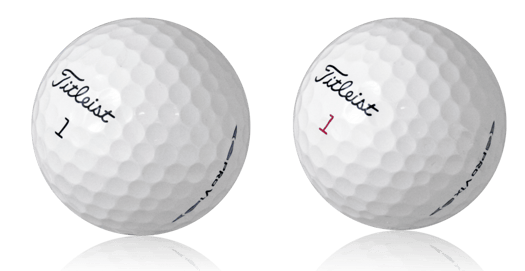
Both the *Pro V1* and *Pro V1x* *2015* models feature an innovative, patented thermoset urethane elastomer cover—designed for long-lasting durability and improved short game performance—as well as an ionomeric casing layer. The control, sound and feel of the Pro V1 and Pro V1x 2015 golf balls give players a noticeable sense of confidence on each approach—while maintaining excellent distance with a softer cover.
In a side-by-side comparison, the *Pro V1 2015* has a generally softer feel than the V1x model and also penetrates a lower launch for more roll and long game spin. The Pro V1 ball is comprised of a unique three-piece, multi-component technology with a very soft compression ZG process core and a spherically tiled 352 tetrahedral dimple design.
The *Pro V1x 2015* has a firmer feel and effectively penetrates a higher launch and more long game spin than the V1 model. The Pro V1x ball is comprised of a distinctive four-piece, multi-component technology with a ZG process dual core and a spherically tiled 328 tetrahedral dimple design.
In terms of appearance: both the Pro V1 and Pro V1x 2015 models are distinguished by a gray-colored arrow marking with a split down the middle.
***In Comparison: The Pro V1/V1x 2013/2014 Model***
***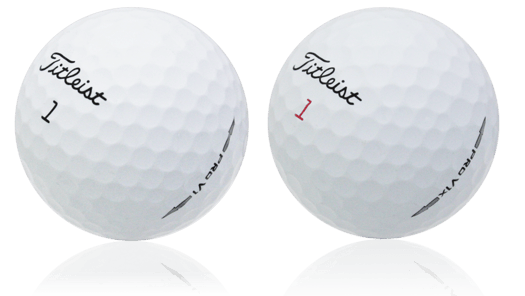***
Titleist’s *2013/2014* *Pro V1 *and *Pro V1x* models all feature Tour-validated technology and performance, designed for increased spin control and a more consistent flight. The Pro V1 and Pro V1x, alike, have an improved A.I.M. (Alignment Integrated Marking) side stamp. Both the Pro V1 and Pro V1x 2013/2014 models are identical—all distinguishable in appearance by a solid, gray-colored arrow marking.
The *Pro V1 2013/2014* is a three-piece golf ball, designed for players with swing speeds from 98 to 105 mph. The Pro V1 has a softer feel around the green, more spin on shorter shots and a penetrating trajectory. It features a spherically tiled 352 dimple design.
The *Pro V1x 2013/2014* is a four-piece golf ball, designed for golfers with swing speeds from 106 mph and above. The Pro V1x has a soft core that spins less off the tee and a soft cover that allows for more spin around the greens with a high launch trajectory.It is comprised of a spherically tiled 328 dimple design.
***In Comparison: The Pro V1 and V1x 2011/2012 Model***
***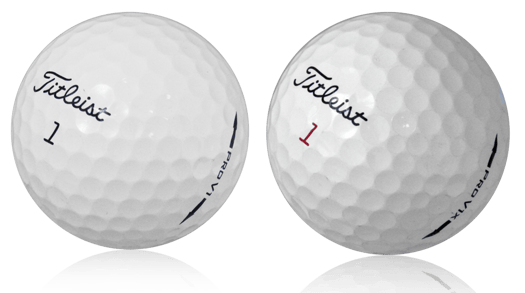***
Like all 2013/2014 models, Titleist’s *Pro V1* and *V1x 2011/2012* balls feature Tour-validated technology and performance, as well as an improved A.I.M. side stamp. The models are distinguished in appearance by a solid, black-colored arrow marking.
The 2011/*2012 Pro V1* is a three-piece golf ball, designed for swing speeds from 98-110 mph. With increased spin control and a more consistent flight, the Pro V1 is made for stabilizing ball flight. It also has a softer feel around the green, more spin on shorter shots and a penetrating trajectory. The Pro V1 2012 features the same spherically tiled 352 dimple design as its 2014/2013 predecessors.
The 2011/*2012 Pro V1x* is a four-piece ball designed for golfers with swing speeds over 105 mph. With exceptional distance and a more consistent flight, the Pro V1x is made to stabilize ball flight. It also features a soft core that spins less off the tee and a soft cover, which allows for more spin around the greens with a low launch trajectory. The Pro V1x 2012 model has the same spherically tiled 328 dimple design as its 2014/2013 predecessors.
**You can find all models of the Pro V1 & Pro V1X up to 50% off retail through the links below:**
[Titleist Pro V1 2015](http://www.lostgolfballs.com/pro-v1/2015/titleist-pro-v1-2015.html) | [Titleist Pro V1X 2015](http://www.lostgolfballs.com/pro-v1x/2015/titleist-pro-v1x-2015.html)
[Titleist Pro V1 2014](http://www.lostgolfballs.com/pro-v1/2014/titleist-pro-v1-2014.html) | [Titleist Pro V1X 2014](http://www.lostgolfballs.com/pro-v1x/titleist-pro-v1x-2014.html)
[Titleist Pro V1 2012](http://www.lostgolfballs.com/pro-v1/2012/titleist-pro-v1-2012.html) | [Titleist Pro V1X 2012](http://www.lostgolfballs.com/pro-v1x/titleist-pro-v1x-2012.html)

###### Heather Plyler
Heather Plyler is a golf enthusiast and has recently joined the E-Commerce team at Lost Golf Balls. She graduated from University of Houston-Downtown in 2013 with a Bachelor’s degree for Corporate Communications. Heather is passionate about golf whether it is playing a round on the course or communicating with others about their last Round. She has been involved in the sport for 10 years that has given her an insight into the commercial value of the products associated with the sport.

- Recent
- Popular
- Categories
### Lists by Topic
- [PGA Events (329)](https://blog.lostgolfballs.com/topic/pga-events)
- [Golf (311)](https://blog.lostgolfballs.com/topic/golf)
- [Golf Trends (297)](https://blog.lostgolfballs.com/topic/golf-trends)
- [Golf Makes the World Go Round (192)](https://blog.lostgolfballs.com/topic/golf-makes-the-world-go-round)
- [On the Course (86)](https://blog.lostgolfballs.com/topic/on-the-course)
- [Golf Balls (76)](https://blog.lostgolfballs.com/topic/golf-balls)
- [Improving Your Game (44)](https://blog.lostgolfballs.com/topic/improving-your-game)
- [PGA Championship (42)](https://blog.lostgolfballs.com/topic/pga-championship)
- [Golf Ball Manufacturers (31)](https://blog.lostgolfballs.com/topic/golf-ball-manufacturers)
- [Golf Courses (17)](https://blog.lostgolfballs.com/topic/golf-courses)
- [LPGA (12)](https://blog.lostgolfballs.com/topic/lpga)
- [Golf Betting (10)](https://blog.lostgolfballs.com/topic/golf-betting)
- [Best Ball For You (9)](https://blog.lostgolfballs.com/topic/best-ball-for-you)
- [U.S. Open (6)](https://blog.lostgolfballs.com/topic/u-s-open)
- [Ryder Cup (4)](https://blog.lostgolfballs.com/topic/ryder-cup)
- [British Open (3)](https://blog.lostgolfballs.com/topic/british-open)
- [FedEx Championship (3)](https://blog.lostgolfballs.com/topic/fedex-championship)
- [Masters 2018 (3)](https://blog.lostgolfballs.com/topic/masters-2018)
- [The Masters (3)](https://blog.lostgolfballs.com/topic/the-masters)
- [2019 Players Championship (1)](https://blog.lostgolfballs.com/topic/2019-players-championship)
- [Bridgestone (1)](https://blog.lostgolfballs.com/topic/bridgestone)
- [LIV Golf (1)](https://blog.lostgolfballs.com/topic/liv-golf)
see all
[Tweets by TwitterDev](https://twitter.com/lostgolfballs)
**Subscribe and Get The Latest News**
**Related Posts**
## [Not Exactly a Fan of the Proposed PGA Tour Schedule for 2028](https://blog.lostgolfballs.com/not-exactly-a-fan-of-the-proposed-pga-tour-schedule-for-2028)
So now we officially know the PGA Tour will undergo a significant schedule change in 2028, though the particulars still have to be ironed out. But I’m not a big fan of what we’ve heard so far with the sole exception being turning the Tour Championship into match play. Essentially, beginning in 2028, the schedule will feature a Championship Series with the biggest names playing for purses over $20 million. There will be the Championship Challenger Series with $4 million purses.
- [Perry Lefko](https://blog.lostgolfballs.com/author/perry-lefko)
- 9 min read
- 01 Jul,2026
## [1 Billion and Counting: PG Golf and LostGolfBalls.com Hit Historic Milestone](https://blog.lostgolfballs.com/1-billion-and-counting-pg-golf-and-lostgolfballs.com-hit-historic-milestone)
A milestone that underscores decades of innovation, sustainability, and trust among 1+ million golfers nationwide. Sugar Land, Texas (June 24th, 2026) PG Golf and LostGolfBalls.com proudly announced today the sale of their 1 billionth recycled golf ball, marking a historic milestone in the company’s mission to make golf more affordable and environmentally sustainable.
- [LostGolfBalls.com](https://blog.lostgolfballs.com/author/lostgolfballs-com)
- 3 min read
- 25 Jun,2026
## [Clark and Burns Play Well, But in the Wrong Tournament](https://blog.lostgolfballs.com/clark-and-burns-play-well-but-in-the-wrong-tournament)
Wyndham Clark (Titleist Pro V1x) and Sam Burns (Callaway Chrome Tour X) did just what I thought they would, albeit a week later. Heading into Canadian Open, I picked Clark and Burns as my two choices in the PG Golf pool. It was the second time using both in the pool, and you are only allowed to pick a player twice. I loved Clark’s form – he had won the CJ Cup Byron Nelson and tied for third in the Memorial Tournament.
- [Perry Lefko](https://blog.lostgolfballs.com/author/perry-lefko)
- 9 min read
- 24 Jun,2026
### Subscribe to Email Updates
[](https://palmspire-3842749.hs-sites.com/growth-home-1)
We help companies and marketers save time and generate more leads via drag and drop HubSpot COS conversion focussed templates.
##### Features
##### About Us
##### Company
© Copyright 2017-18
SIGN UP FOR OUR NEWSLETTER
-
-
-
-
-
About Us
- [LGB Story](https://www.lostgolfballs.com/aboutus)
- [Press Room](https://www.lostgolfballs.com/pressroom)
- [Why Used](https://www.lostgolfballs.com/whyused)
Support
- [Contact Us](https://www.lostgolfballs.com/contacts)
- [Shipping Policy](https://www.lostgolfballs.com/shipping)
- [Return Policy](https://www.lostgolfballs.com/returns)
- [FAQs](https://www.lostgolfballs.com/faqs)
Explore
- [Best Ball For You](https://info.lostgolfballs.com/whats-the-best-ball-for-you)
- [Blog](https://blog.lostgolfballs.com/)
- [Golf Tips](https://www.lostgolfballs.com/golftips)
- [Grading Scale](https://www.lostgolfballs.com/gradingscale)
Wholesale
- [Selling Golf Balls](https://www.lostgolfballs.com/We-Buy)
- [Bulk Orders](https://info.lostgolfballs.com/wholesale-golf-balls-lostgolfballs)
- [School Orders](https://info.lostgolfballs.com/school-orders)
Browse
- [ProV1/ProV1x](https://www.lostgolfballs.com/golf-balls/brands/pro-v1.html)
- [Titleist](https://www.lostgolfballs.com/golf-balls/brands/titleist.html)
- [Bridgestone](https://www.lostgolfballs.com/golf-balls/brands/bridgestone.html)
- [Callaway](https://www.lostgolfballs.com/golf-balls/brands/callaway.html)
- [Nike](https://www.lostgolfballs.com/golf-balls/brands/nike.html)
- [Srixon](https://www.lostgolfballs.com/golf-balls/brands/srixon.html)
- [Taylormade](https://www.lostgolfballs.com/golf-balls/brands/taylormade.html)
- [Refinished](https://www.lostgolfballs.com/golf-balls/quality/refinished.html)
- [Deals](https://www.lostgolfballs.com/deals.html)
- [Accessories](https://www.lostgolfballs.com/golf-accessories.html)
Copyright © 2020 www.Lostgolfballs.com • All Rights Reserved.
- [Terms And Conditions](https://blog.lostgolfballs.com/termsandconditions)
- [Privacy Policy](https://blog.lostgolfballs.com/privacy-policy)
- [Ad And Cookie Policy](https://blog.lostgolfballs.com/ad-and-cookie-policy)
- [Sitemap](https://blog.lostgolfballs.com/catalog/seo_sitemap/category)
California:
- [Your Privacy Rights](https://blog.lostgolfballs.com/privacy-policy#ccpa)
- [Do Not Sell My Info](https://blog.lostgolfballs.com/do-not-sell-my-info)
